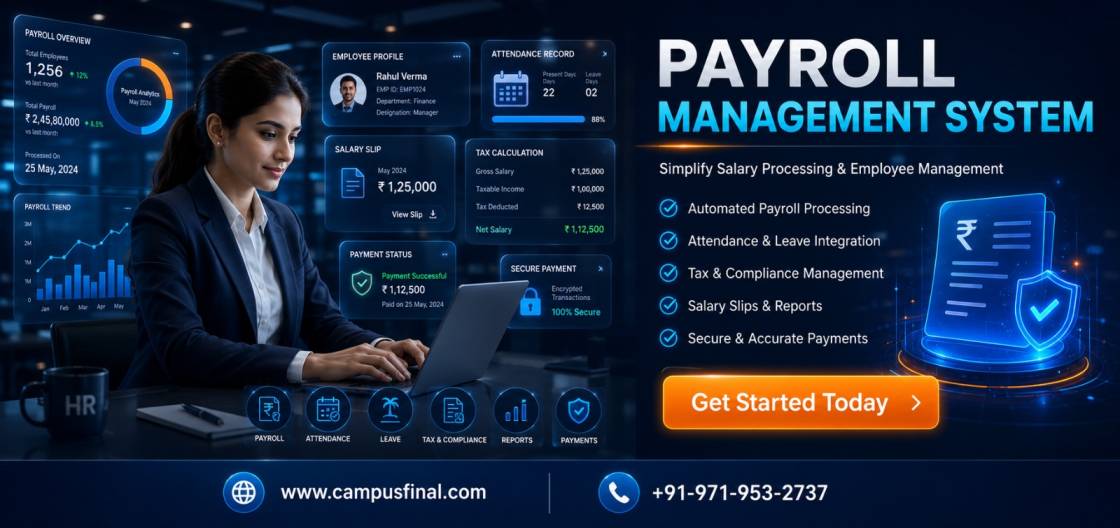
A Payroll Management System (PMS) is a software application used by organizations to manage employee salaries, wages, bonuses, deductions, taxes, and other financial records. It helps businesses automate payroll processes. Reduce errors, save time, and ensure employees are paid accurately and on time with best payroll management software.
In today's digital world, organizations of all sizes use payroll software to simplify salary processing and maintain employee records efficiently. This system plays an important role in Human Resource Management (HRM) and financial operations.
It is a computerized solution that calculates employee salaries based on attendance, working hours, leave records, overtime, tax deductions, and other payroll-related information.
Read Also: Best School Management System
The system automatically generates salary slips, maintains employee records, calculates taxes, and prepares payroll reports. This reduces manual work and increases accuracy.
Payroll is one of the most critical functions of any organization. Employees expect accurate and timely payment for their work. The Payroll Management System helps organizations:
The main objectives of a Payroll Management Software are:
A modern Payroll Software includes several useful features:
Stores employee details such as:
It is useful for attendance management. You will track attendance:
Using payroll software you can automatically calculates:
By using payroll management software, you can calculates:
Generates salary slips that employees can download or print.
Payroll management software provides reports related to:
Protects sensitive employee and salary information through authentication and authorization.
The Payroll Organization System is generally divided into the following modules:
Employee Module
Manages employee information and personal records.
Attendance Module
In attendance module, you can records attendance and leave information.
Payroll Processing Module
Calculates salaries and deductions automatically.
Tax Management Module
Handles tax calculations and compliance requirements easily with tax management module.
Reporting Module
Generates payroll and financial reports.
Administrator Module
Allows administrators to manage users and system settings.
The Payroll Organization System follows a simple workflow:
Step 1: Employee Registration
First you need to do employee registration. Employee details are entered into the system.
Step 2: Attendance Recording
Attendance and leave information are collected.
Step 3: Salary Calculation
The system calculates salary based on attendance, allowances, and deductions.
Step 4: Tax Deduction
Applicable taxes and contributions are deducted.
Step 5: Payslip Generation
Salary slips are generated automatically.
Step 6: Salary Payment
Employee salaries are processed and transferred.
Step 7: Report Generation
Payroll reports are generated for management review.
It offers several benefits:
1. Accuracy
Reduces calculation errors.
2. Time Saving
Automates repetitive payroll tasks.
3. Cost Effective
Reduces administrative expenses.
4. Better Record Keeping
Maintains organized employee records.
5. Legal Compliance
Helps organizations follow tax and labor regulations.
6. Employee Satisfaction
Ensures timely and accurate salary payments.
7. Data Security
Protects confidential payroll information.
Despite its benefits, some limitations include:
The system can be developed using various technologies:
Front-End Technologies: In front-end we use given mentioned technologies.
Back-End Technologies: In back-end, we use given technologies:
Database
Development Tools
Common database tables include:
Employee Table: An employee table contains:
Attendance Table: It stores attendance records.
Payroll Table: Maintains salary calculations.
Department Table: Stores department information.
Leave Table: Tracks employee leave requests.
User Login Table: Handles authentication and access control.
Payroll Management Systems are widely used in:
The future of payroll management is becoming more advanced through:
These technologies will make payroll processing faster, smarter, and more secure.
Organizations may face several payroll challenges:
A well-designed Payroll Management System helps overcome these challenges effectively.
A Payroll Management System is an essential software solution for managing employee salaries and payroll operations efficiently. It automates salary calculations, attendance tracking, tax deductions, report generation, and employee record management.
Read Also: Best Attendance Management System Software
By reducing manual effort and improving accuracy, payroll management systems help organizations save time, maintain compliance, and increase employee satisfaction.
As businesses continue to adopt digital technologies, Payroll Management Software will remain a vital tool for effective workforce and financial management. Call us or WhatsApp us for free demo or more information.
What is a Payroll Management System?
A Payroll Management System is software that automates employee salary calculation, payment processing, tax deductions, and payroll reporting.
Why is a Payroll Organization System important?
It improves accuracy, saves time, reduces errors, and ensures timely salary payments.
What are the main modules of a Payroll Software?
The main modules include Employee Management, Attendance Management, Payroll Processing, Tax Management, Reporting, and Administration.
What are the benefits of Payroll Organization Software?
Benefits include automation, accuracy, data security, compliance management, and better employee satisfaction.
Which industries use Payroll Management Systems?
Almost all industries, including IT, healthcare, education, manufacturing, retail, and government sectors, use payroll management systems.
Read Also:
Explore our ERP management software solutions.

Campus Final is the best School mangement system that provides all in one solutions for schools and colleges like fee management, school information system, and more.